RESEARCH · JAN 2025
Financieel gedrag model
An academic behavioral model analyzing what drives healthy financial behavior in Dutch students: the research foundation behind Fix Your Room.
Introduction
This behavioral model was developed to understand which factors influence healthy financial behavior among Dutch students. Healthy financial behavior is defined in this model as behavior that leads to a stable financial situation, in which students are satisfied with their financial status, have no excessive debt, and experience little financial stress.
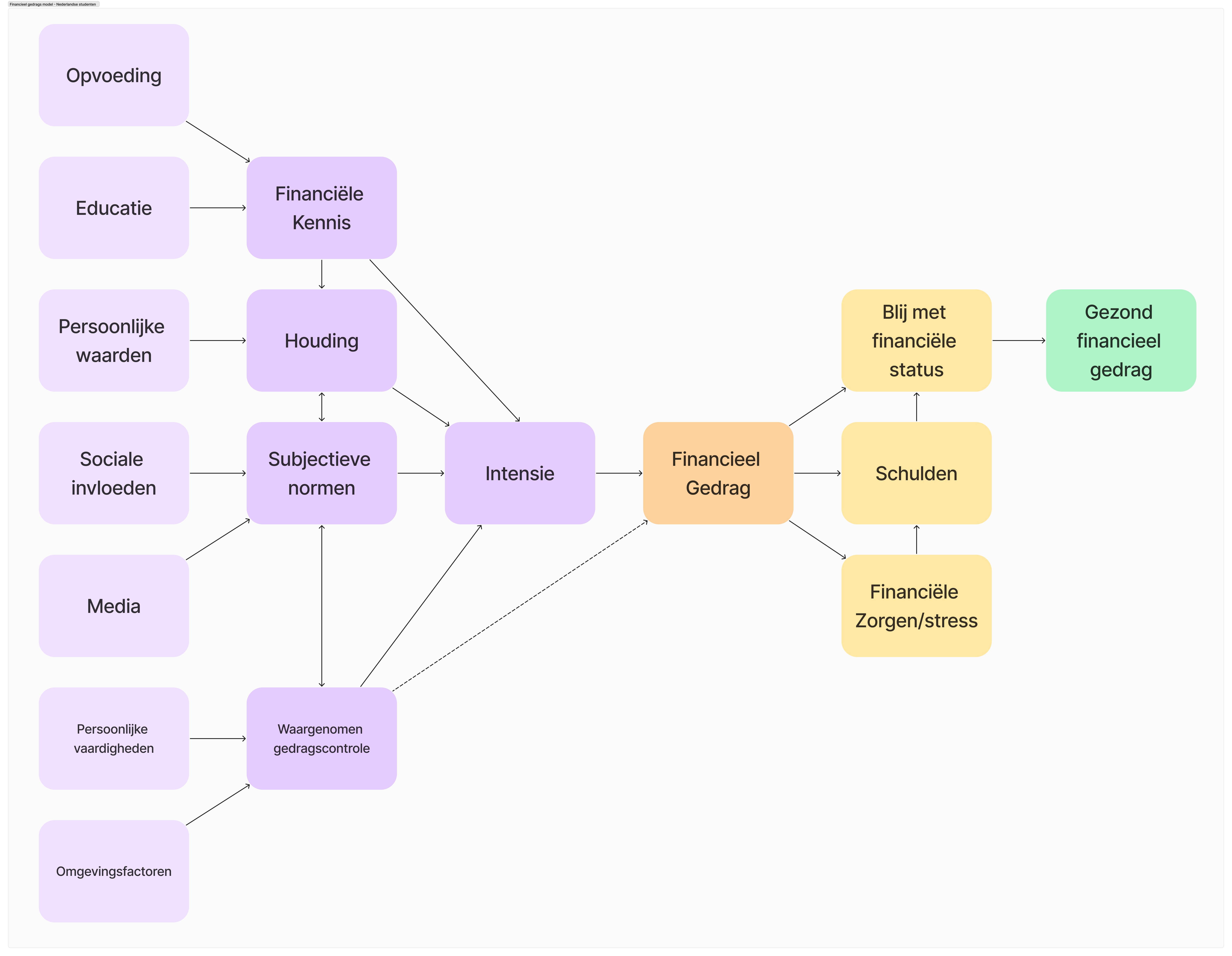
The model identifies several core variables that mutually influence each other and ultimately determine financial behavior. These variables are divided into factors that have a direct and an indirect influence.
Model
The behavioral model serves as a tool to analyze what has a direct and indirect effect on students' financial behavior. The model is divided into four categories, each with a unique role in explaining healthy financial behavior:
- Intention (Purple): A student's determination to display healthy financial behavior. This is influenced by financial knowledge, attitude, subjective norms, and perceived behavioral control.
- Financial Behavior (Orange): The actual actions and choices a student makes, such as saving, borrowing, and budgeting. This behavior is the direct result of intention and perceived control.
- Status (Yellow): The financial situation resulting from the student's behavior. This includes satisfaction with financial status, debt, and financial stress.
- Healthy Financial Behavior (Green): The ultimate goal of the model. Healthy financial behavior leads to a stable financial situation with satisfaction, minimal debt, and little stress.
1. Intention
Intention is the central factor that drives financial behavior. It is a student's determination to display healthy financial behavior. This intention is influenced by various factors:
Financial knowledge
Financial knowledge encompasses the understanding of financial concepts such as budgeting, managing debt, and saving. It can be built through:
- Upbringing: The influence of parents and caregivers on a student's financial literacy.
- Education: Lessons at school or workshops aimed at financial education.
Attitude
Attitude refers to a student's beliefs and emotions about financial matters. This is shaped by:
- Personal values: Such as responsibility and independence, which can positively motivate a student.
Subjective norms
Subjective norms refer to the social pressure a student experiences. Important factors here are:
- Social influences: The expectations of family, friends, and other social groups.
- Media: The influence of advertising, social media, and news on financial decisions.
Perceived behavioral control
Perceived behavioral control concerns the extent to which a student believes they are able to carry out healthy financial behavior. This consists of:
- Personal skills: Such as budgeting, planning, and problem-solving ability.
- Environmental factors: Such as access to financial resources and support from society.
2. Financial Behavior
Financial behavior encompasses the actual actions students take regarding finances, such as saving, borrowing, and budgeting. This behavior is directly determined by intention and perceived behavioral control.
3. Status
A student's financial status is an important outcome of their behavior. This status is influenced by:
- Satisfaction with financial status: Happiness and satisfaction with one's own financial situation.
- Debt: The level and management of any loans or debts.
- Worry/stress: The amount of financial stress a student experiences.
4. Healthy Financial Behavior
Healthy financial behavior is seen as the ultimate goal of this model. This includes maintaining a stable financial situation with:
- A sense of satisfaction.
- Minimal or manageable debt.
- Little to no financial stress.
How you could use the model
The model offers a framework that can be used in various contexts:
- Problem analysis: Organizations can apply the model to gain a better understanding of their target audience. For example, when designing solutions for students' financial problems, the model can help identify bottlenecks and which interventions are likely to be most effective.
- General use as a template: The model is flexible and can be adapted for other target audiences, such as working professionals or retirees, or for other behaviors, such as eating healthier or living more sustainably.
- Research: The model can serve as a basis for further research into behavioral change in financial choices and well-being.
- Education: Schools and universities can use the model to develop targeted curricula that prepare students for financial independence.
- Policy development: Policymakers can apply the model to design interventions that reduce debt and financial stress among students.
- Personal guidance: Financial advisors can use the model to identify specific areas where students need extra support.
How I applied the model
The behavioral model clearly shows where the biggest influence(s) on healthy financial behavior lie. In the case of the app I applied it to, this turned out to be intention, and within that, the biggest factor was students' attitude. Following a test of our product, students made choices based on their own preferences, without looking at the amount. For instance, one person preferred eating popcorn with a movie, while another preferred going out.
After the student has gone through all the choices, we show an overview of their choices. This overview highlights which decisions contribute to healthy financial behavior and which don't, allowing students to further develop their financial knowledge and skills.
Finally, we addressed subjective norms by creating an online version, where you can upgrade your room fastest by making financially healthy choices. This way, students experience pressure from other students to perform well.
In these ways, we address multiple intention factors for a Dutch student to adjust their financial behavior, which leads to healthy financial behavior.
So our app doesn't do anything with the person's financial status.
Conclusion
The behavioral model shows how factors such as financial knowledge, attitude, subjective norms, and perceived behavioral control contribute to students' intention and behavior. By focusing on education, personal values, social influences, and skills, students can be supported in achieving healthy financial behavior, which ultimately leads to a better financial status and well-being.
Sources
- Shim, S., Barber, B. L., Card, N. A., Xiao, J. J., & Serido, J. (2010). The Student Financial Well-Being Model.
- Xiao, J. J., Tang, C., & Serido, J. (2020). Conceptual Model of Financial Behavior and Quality of Life.
- Boomstrategie. (n.d.). Influencing behavior with Ajzen's Theory of Planned Behavior.
- Janssens, K., Verhofstadt, L., Vervoort, T., & Loeys, T. (2023). Journal of Social and Personal Relationships.
- Raymond van Dongelen, (2024). Conceptual model
- Research insights from desk research and test results
Related
Skills